The statistics quoted in this post are based upon extensive research. I built a data base by manually extracting data from the US Federal census starting in 1860. I am up to 1930 and have thousands of records. I also extracted deeds for homes located on Mission, New, Washington and Wheeler Street matching those home with the census data.
I have begun to “synthesize” the data: birthdate, place of birth, occupation, address, mother and father’s birthplace, etc., every data point included in the census.
I have found some extraordinary information. For example, there were children as young as 12 working as servants in Montclair homes at least up to 1900. Admittedly not many. But the legacy of slavery has left its mark on Montclair.
The evidence that Montclair has a history of racism and practice of segregation led me to investigate the inequities of housing discrimination and the ongoing practice that has caused the displacement of many residents.
Beginning in 1870, former slaves were imported to Montclair to work as servants in homes of wealthy white residents.
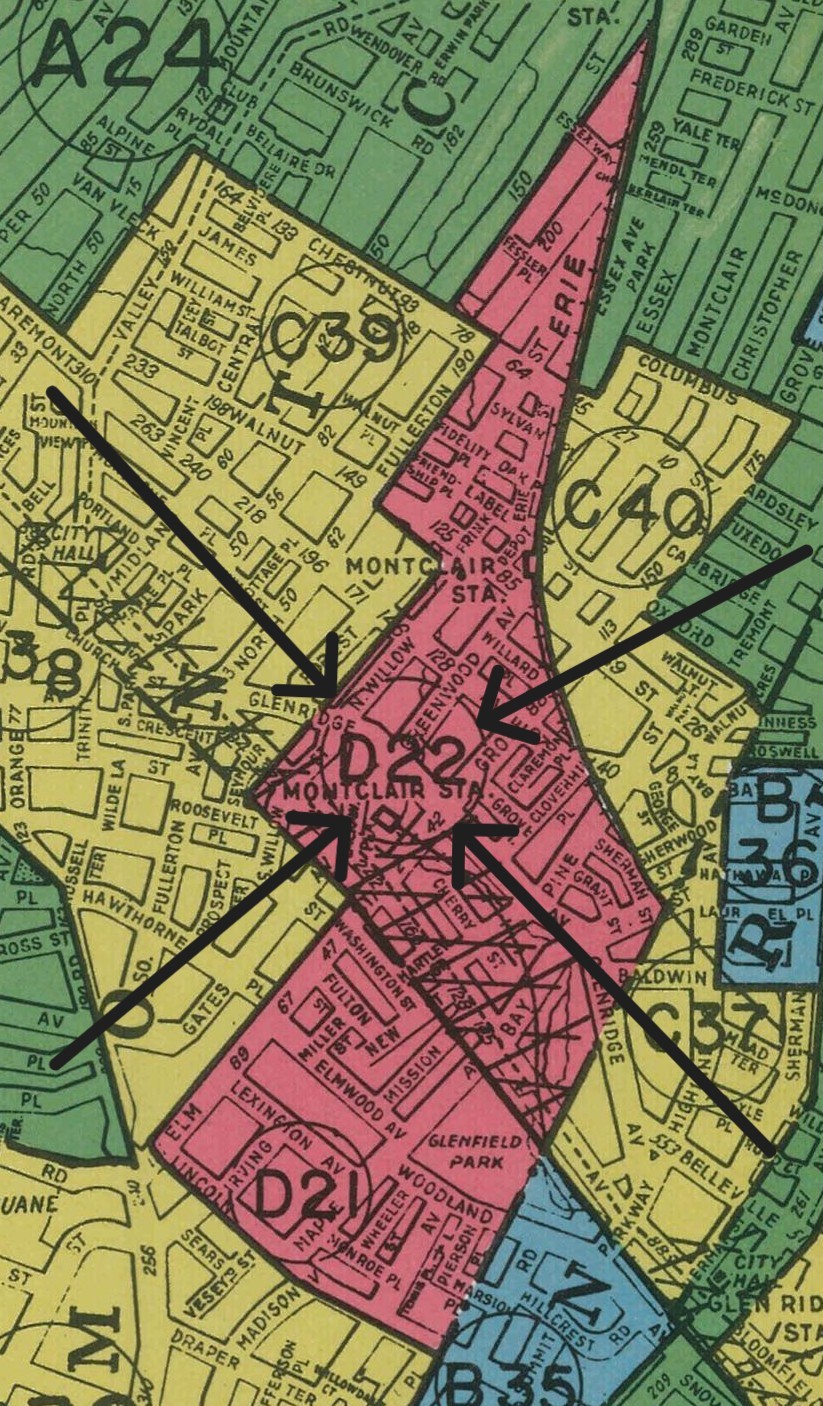
By 1900, over 52% of African Americans living in Montclair were born in Virginia and one-third lived on streets that would be redlined by the Federal Government in 1939.
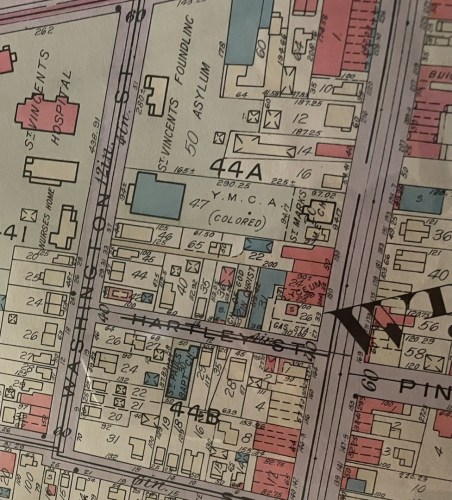
The 1933 map produced by the Franklin Survey Company clearly describes the YMCA on Washington Street as colored. Redlining did not create segregation; it codified the practice.
The people who lived in the fourth ward of Montclair for over a century have not benefitted from the appreciation of real estate values in Montclair.
House after house was sold at sheriff sale, foreclosed upon, or subject to multiple tax lien sales at extraordinarily high rates.
High rates that you do not see in the first and second wards of Montclair, the historically blue and green lined neighborhoods, the first and second-class properties, as opposed to the fourth-class undesirable, segregated, red-lined neighborhoods north and south of Bloomfield Avenue.
Because of the classification of these properties, banks could deny loans to the black occupants as being too risky. So, residents were forced into fourth-class status, unable to get a loan or borrow capital, as first- and second-class residents could. Fourth-class residents occupied buildings that were often allowed to deteriorate, as residents were not valued enough by property owners to ensure they had access to equitable housing.
The denial of access to credit is like economic sanctions the US imposes to control outcomes throughout the world. So, the fourth-class residents formed their own community where they were forced to live, where they could feel secure.
Residents who have been displaced have not benefited from their century of custody. Instead, outside interests, people who have never lived in Montclair or the fourth ward have been enabled by Township leadership to extract all the wealth.
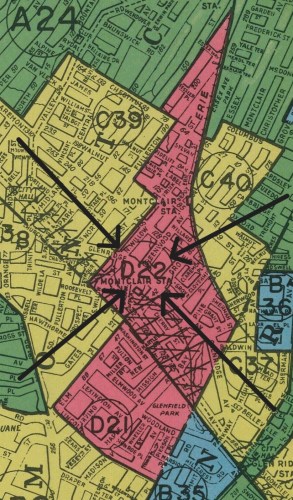
When you look at the red line map of Montclair and focus on D22 you see that Lackawanna Plaza, where the Pathmark supermarket was located, is the center of the segregated neighborhoods of Montclair. These red-lined districts form the heart of Montclair, and the center of that heart was the supermarket, closed for over 10 years, that served friends, families and neighbors for decades.
Naturally occurring affordable housing created by the practice of segregation has been converted into luxury unaffordable housing by the same system of institutionalized racism.
When you consider legislation to affect outcomes, you must understand the failed policies of the past if you plan to have a positive impact on equity.
Read more about the legacy of slavery in Montclair EXPLOSION WRECKS A HOUSE Red Lining and explore Montclair Progressive or Corrupt pages to learn more about how fraud and corruption undermine democracy and create inequity.
 Montclair Progressive or Corrupt
Leave a comment