The Township of Montclair has a history of racism and the practice of segregation. The southern end of the Fourth Ward of Montclair includes all three (3) former red-lined districts within Montclair. These neighborhoods were primarily populated by white people when built, as far back as 1895, but by the early 20th century, due to the practice of segregation, became primarily inhabited by African Americans.
By the 1930’s this area became increasingly populated by African Americans and subjected to the Federal Government policy of red lining, preventing African Americans from property ownership, and subjecting the residents to financial and educational discrimination resulting in the economic disparity that persists today.
Education is the primary tool used to oppress a class of people in order for the upper class to maintain their authority and superiority, and depriving the segregated community of their right to economic and intellectual prosperity.
The Report of the Survey of the Public Schools of Montclair
In 1947, the Township of Montclair engaged the Institute of Field Studies of Teachers College, Columbia University to make a comprehensive study of the public schools. The 726-page document was published in 1948 entitled The Report of the Survey of the Public Schools of Montclair.
The areas surveyed studied includes: Organization and Administration, School Improvement, Evaluation and Public Relations, Personnel Administration, School Business Administration, Cafeteria Services, School Buildings, Financing the Schools, The Administration of Elementary Schools, The Organization and Administration of the Secondary Schools, Organization of Education for Occupational Adjustment, Post-High School and Adult Education, Guidance, Kindergartens, Curriculum and Teaching, Curriculum for Youth Education, Special Education, Instructional Materials and Resources, and Procedures for Improving the Curriculum and Teaching.
The Survey includes an extensive level of detail relating to costs and expenses, in every area, from teacher and administrative salaries to janitorial services; from maintaining attendance records to scrubbing toilets, and including rating each school’s level of cleanliness.
The Foreword states “The residents of this city have been alert to the significance of good schools; they have continuously supported them; and their interest in providing children with a superior education shows no sign of waning.” (The Report of the Survey of the Public Schools of Montclair, Rutgers University, page xvii)
Nine Goals
The comprehensive study laid out nine (9) goals focused on: i. educational progress, ii. needs and abilities of pupils, iii. best possible structure, iv. control and administrative organization, v. all personnel, vi. business administration, vii. economical use of the school facilities, viii. school financing, and ix. relationships between the school system and the community.
Fifty-three (53) members of the Teachers College Columbia University staff participated in the survey and contributed to the report.
Not-Passing Rates
A section on “Shifting Enrollment Trend” (Ibid, page 160) reveals that due to shifting enrollment trends sharp steady decreases at Glenfield, Rand and George Washington Schools had occurred, while the heavy concentration of new residential construction was creating overcrowded conditions in the north and northeast sections in both the Bradford and Northeast Schools.
The survey determined that the system-wide rate of non-promotion was low, although a marked difference between elementary schools was observed. The data in Table 46 (Ibid, page 228) has been recreated for comparative purposes.
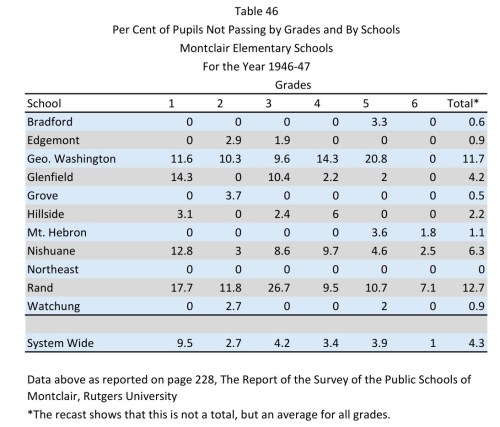
Table 46 presented the not-passing data by elementary school in alphabetical order and no discernable pattern of not-passing can be determined, without further analysis. However, the survey’s authors later conclude that it is the individual philosophy of each school’s administration that accounts for the dramatic variations. The raw not-passing data shows that Geo. Washington, Glenfield, Nishuane, and Rand have significantly higher not-passing rates than any of the other schools.
Montclair’s Children
Chapter XIV, Curriculum and Teaching in Elementary Schools, section headed “Montclair’s Children” observes that the Township’s children are unique individuals “like children everywhere.” A casual observer would notice that the children “differ in height, weight, color, and the like.” The survey goes on to point out that there are background differences between children due to “social position” and “economic status” (All quotes Ibid, page 423), offering as an example that some parents are wealthy while others have low income.
The survey then reaches a remarkable conclusion “Although the accident of geography occasionally tends to produce a student body representing preponderantly either one or the other of these economic groups, there are some schools where both groups are about equally present.” (Ibid, page 423)
Neighborhood School Policy
Montclair had a long-standing Neighborhood School Policy. Elementary school district perimeters were drawn so that children would not be more than half a mile from the school they attended. Junior high school perimeters were a mile.
By the early 1960’s Montclair’s Neighborhood School Policy came under attack for de facto segregation. The BOE voted in early March 1965 to bus 5th and 6th graders from Edgemont to Nishuane at the start of the 1965-66 school year. Montclair residents were vehemently opposed to using “artificial devices such as busing and gerrymandering of school districts” (Laeng Heads School Group, The Montclair Times, June 24, 1965, page 2) and pushed back to prevent any change to the Neighborhood School Policy status quo.
When Table 46 is sorted by Ward, from north to south, and the racial composition is layered in, a different picture emerges.
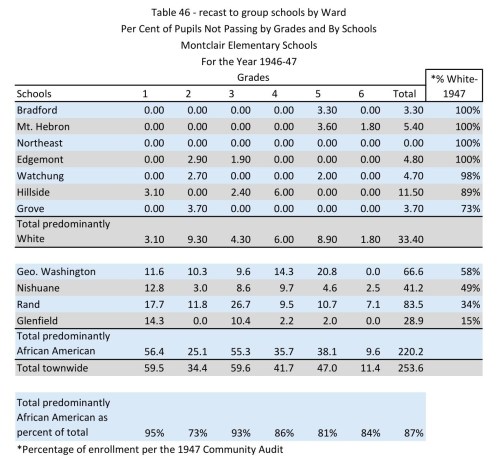
What The Report of the Survey of the Public Schools of Montclair (“1948 Report”) omits from the findings is the stunningly high failure of the elementary schools of Montclair to identify the obvious discrimination in public education present in Montclair, which can only be characterized as Institutionalized Racism.
Junior High Schools
With respect to Junior High Schools, the 1948 Report makes a definitive recommendation to reduce the four (4) junior high schools to two (2) based upon the Neighborhood School Policy of a one (1) mile travel distance and the cost of maintaining and operating them. (Ibid page 174 and Columbia Report Quoted on Junior High Schools, The Montclair Times, September 14, 1961, page 8) The 1948 Report found that the optimal number of students in a junior high school should range from between 500 to 800 students to economically provide the best education. All four (4) of Montclair’s Junior High Schools had about 300 students each.
No action was taken to address the recommendation although enrollment at Glenfield Junior High continued to decline over the next decade.
In September 1961, the NAACP pressed for closing Glenfield Junior High as the low enrollment made it impossible to provide an educational program comparable to the other junior high schools within the district. However, the NAACP’s plan to eliminate Glenfield a s a junior high school and distribute the 7th and 8th grade pupils between Hillside and Mount Hebron Junior High Schools was met with another decade of protest from the majority white families in the First and Second Wards.
When the NAACP’s plan to address the deteriorating conditions for the African American junior high students attending Glenfield was rejected, they asked “in the interest of better education for all in Montclair” (emphasis added) “why has nothing been done about the problem of low student enrollment…although this has been a matter of record since the Columbia University report of 1948”. (School Fight by NAACP To Continue, Montclair Times, September 7, 1961, pages 1 and 4)
The phrase “better education for all in Montclair” was later appropriated by a group of parents in February 1971, who called their group BEAM, Better Education for All Montclair, in resistance to the “Interim Plan” and their preference for maintaining the Neighborhood School Policy status quo.
Interim Plan
The Interim Plan (no. 8 in the series of plans to address segregated schools) preserved the Neighborhood School Policy for K-4, middle school students were split between Nishuane and Glenfield (5th grade) and Hillside (6th grade). BEAM succeeded over time in influencing significant number of voters to oppose mandatory desegregation, and remained active throughout the 1970’s.
In the face of the increasing influence of the Civil Rights movement in the country and state legislation addressing the de facto segregation of public schools in New Jersey, the BOE organized the Taylor Committee.
Taylor Report
There were 250 applicants to join the committee, from which 30 members were selected. The Taylor Committee published the Taylor Report (“the Report”) in March 1962 approved by a 27-member majority of the committee. A simultaneous report issued by the minority claimed that integration was not a problem to be solved by the BOE.
The BOE held a hearing soon after the Taylor Report was issued, and as reported in The Montclair Times, 2,500 residents attended the hearing (Taylor Committee Report Draws Praise, Criticism From Public at Hearing, The Montclair Times. April 12, 1962, page 1)
The geographic location of each speaker critical of the Report’s recommendations mirrors the First and Second Wards, conversely, the geographic location of each speaker approving the Report’s recommendation mirrors the Third and Fourth Wards.
First and Second Ward residents complained that the recommendation to transfer the Glenfield Junior High students to Hillside and Mount Hebron, did not speak for the best interests of Montclair.
The representative for the Fieldstone Association Group opposed to busing Glenfield Junior High students to Mount Hebron stated “For the board to act on the principle of correcting racial imbalance, as has been suggested, would deny the constitutional rights of the children in our schools. For any group to seek to arrogate to itself a preferred position, to demand that its conception of social justice be adopted under threat of chaos and violence, is not liberty, it is tyranny.” (Ibid, page 4)
Morean v. BOE
Not long after the Taylor Report was published, families from the First Ward filed a lawsuit to compel the BOE to terminate busing of the Glenfield Junior High students, alleging that the BOE had “adopted a double standard of school assignment” by applying the existing model in which students attended schools in close proximity to their homes (Neighborhood School Policy) “on a selective basis”. The families complained that the Neighborhood School Policy was applied throughout Montclair except for residents of the Glenfield Junior High zone and hereby deprived them of equal protection of the laws. (Morean v. Bd. Of Educ. Of Town of Montclair, 200 A.2d 97, 42 N.J. 237, May 4, 1964)
In the May 4, 1964 ruling, State Education Commissioner Raubinger dismissed the claim that the BOE had a double standard or was racially motivated with the objective of controlling the racial balance of students. Furthermore, Raubinger ruled that the Petitioners relied upon holdings that prove the opposite. It had already been established that segregation is unconstitutional (Goss v. Board of Education, 373 U.S. 683 1963)
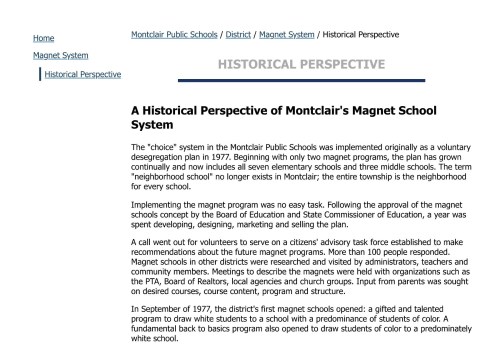
As described by Mary Knowles in her report School Desegregation in Montclair, New Jersey, 1961 – 1977, (Rutgers-Newark, Political Science Graduate Program) there were at least fifteen (15) desegregation plans over the course of the fifteen (15) Year period (page 9) culminating in the Full Voluntary Magnet Program, plan sixteen (16), in 1979 in which all attendance zones were eliminated. (page 43)
It is noteworthy that the Montclair Board of Education website history page on the Magnet system begins in 1977 and excludes the decades long struggle to desegregate the schools spanning from 1948 to 1979 that culminated in the Magnet system which persists today.
The Rice v. Montclair Board of Education complaint filed in April 1966 is frequently cited as a deciding factor in the struggle to integrate the Montclair Schools. It certainly focused the State Education Commissioner’s attention on segregation in Montclair, however, I think it is a mistake to ignore the two (2) decades of struggle that preceded the case.
Even today, election results on divisive public education questions follow the same geographic patterns of the 1964 and 1966 referendums which sought to provide financing for solving the segregation crisis. Both financing referendums were voted down by the majority of township residents who wanted to preserve the Neighborhood School Policy and were the vocal opponents to accepting any alternatives that the Board of Education and the Administration crafted after much study, discussion, and debate were offered as options to address the staggering pattern of discrimination in public education.
The 1964 referendum for financing a central junior high school to provide a permanent solution to segregation at the junior high school level was resoundingly voted down by the residents of the Northside of town, with 75% of Ward 1 voting No.
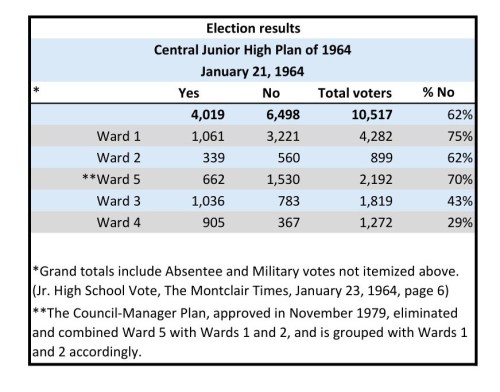
Similarly, the 1966 Montclair Education Plan seeking authority to issue bonds to finance the cost of creating two (2) middle schools was voted down by 66% of the residents of Ward 1.
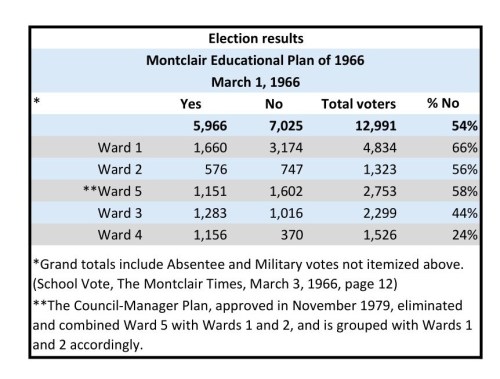
Contrast the result of these referendums in 1964 and 1966, where the wealthy privileged white residents of Upper Montclair (geographically the first and second wards) refused to fund any solution for the issues of inequity in education as a result of segregation, with the Special School Election of 2026.
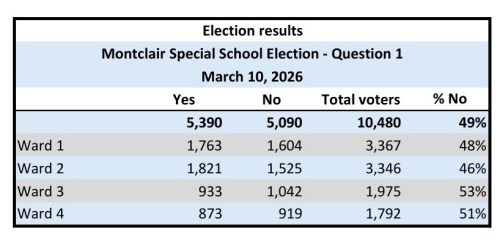
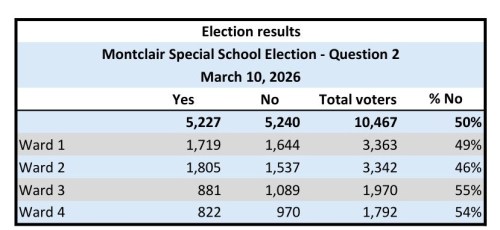
Residents are now burdened with additional tax assessments to cover up corruption in the public schools. It is unthinkable, yet there are many who support doing just that; paying to cover up fraud and financial malfeasance rather than root out the bad practices that are causing financial stress on the community.
And how can those same wealthy privileged residents of Upper Montclair accuse residents of being selfish for wanting to do the right thing; holding those accountable for the financial mismanagement and for the role they played in causing this catastrophe.
When the wealthy, privileged white residents of Upper Montclair didn’t want to pay to end segregation in the public schools they complained that it was their rights that were being violated, not those who suffered from the discrimination of institutionalized racism.
That sounds like the same thing people in Upper Montclair say today – that residents in the South End of town are imposing their will upon the residents of Upper Montclair, by demanding fraud and financial malfeasance be addressed.
A full understanding of the struggle to desegregate the Montclair Public Schools is not complete without reading Selling Integration: A History of the Magnet School System In Montclair, New Jersey, by Jane Caroline Manners, Harvard College, February 28, 1997 which can be accessed in the Montclair Public Library, Local History Room, and School Desegregation in Montclair, New Jersey, 1961-1977, Mary Knowles, November 15, 2006, which can be easily accessed from the Montclair Public Library website.
The above analysis has been performed to provide a fulsome understanding of the extent of segregation and discrimination in Montclair so as not to forget those who suffered great hardship for no other reason but for the color of their skin.
 Montclair Progressive or Corrupt