I have been investigating the phenomenon of luxury housing development in historically African American neighborhoods in Montclair that were redlined by a Federal government agency in the 1930’s. The Home Owners’ Loan Corporation graded residential security of American neighborhoods from a standpoint of investment risk. Neighborhoods in Montclair roughly north and south of Bloomfield Avenue adjacent to the railroad tracks were graded “D” and colored red, a warning sign to potential lenders that underwriting loans were extremely susceptible to risk of loss. Hence the term “redlining”.
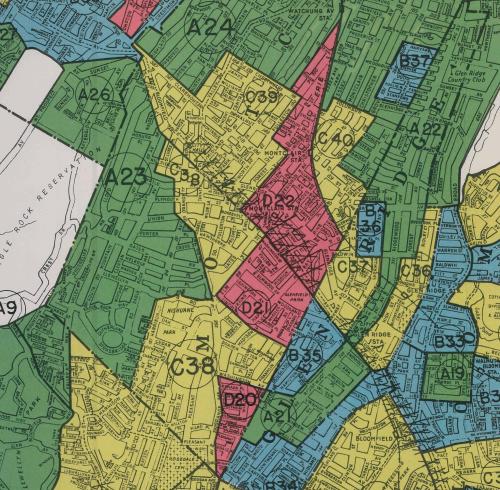
I have extracted data from the US Federal census that shows the former slaves and descendants of slaves that were brought here as servants and general menial labor starting in 1860s, were forced to live in the fourth ward immediately north and south of Bloomfield Avenue along the train tracks. This is the typical growth of American cities. All the grittier neighborhoods typically associated with commerce were allocated to the subservient class of society.
This is no exception in Montclair. And these neighborhoods became increasingly populated by people of color until the point whereby the schools became segregated. Large swaths of these neighborhoods were classified by the Federal Home Loan Bank as being too risky to offer mortgages, due to the color of the skin and the lack of education of the residents. The census reports whether each resident attended school and/or could read or write.
There are people of color born in NJ living in Montclair in 1930 who were born in the twentieth century, who never went to school, even though Nj state law required everyone to go to school.
Just imagine Montclair with the wealthy educated white folks employing the uneducated formerly enslaved persons and their descendants to perform all the menial labor in their homes, or chauffeuring them in fancy vehicles or horse drawn carriages around town. Going home at night to the hollow or the tenements on Pine Street, the row style houses on Mission, New, Washington, and Wheeler Streets, or Rag Row on Glenridge Avenue.
They could not buy their homes because the Federal government would not lend to them. And so you see how the foundation for the great economic gulf that divides the classes today was built.
I moved to Montclair in 1987, and to my current home in 1989. I live in the South end, in the formerly redlined district 21. I am a native of New Jersey, born in Paterson, raised in Bergen County, and it was Montclair’s progressive reputation that drew me here. My children, who are bi-racial, were all born here. My knowledge of the African American history of Montclair was limited to the understanding that certain neighborhoods were predominantly occupied by people of color and that realtors would not show homes to white people in the South End.
I have been monitoring two-family home sales in Montclair for about ten years. I was fortunate to inherit a modest sum of money upon my Mother’s passing in 2014 and decided to buy a house on Wheeler Street. My daughter, son-in-law and grandson, the fourth generation of a Montclair family, live there now.
In 2021, 13 Wheeler Street, a couple doors down, was purchased by an “investor” for $325,000. I believe the owner may have been facing foreclosure. Two houses were built, with multiple variances granted by the township, and sold for a combined total of $2.8 million. And so, my investigation into predatory profiteering in a neighborhood that was populated by former slaves and descendants of slaves was launched.
I collected data on all the property transactions on Mission, New, Washington and Wheeler Streets and observed the rapid conversion of these neighborhoods from naturally occurring affordable housing to luxury high rent apartments. I spoke out frequently at planning board, zoning board and council meetings about what I observed to blank stares and inaction.
I began to question myself. How did I know that these neighborhoods were historically African American?
I went to the library and read every book in the Montclair local history collection searching for the history of these neighborhoods and found nothing. The written history of Montclair celebrates the original settlers, the scions of industry, the wealthy celebrities, but I could not find any mention in any book of the African American people who lived here.
Montclair promotes an image of having progressive values that include economic equity, educational equality and inclusive affordable housing. But what Montclair has achieved, despite decades of claiming racial and socioeconomic diversity, is gentrification.
By extracting data from the US Federal Census between 1870 and 1930, I discovered that the Township of Montclair has a history of racism including the practice of segregation, that has been hidden from view.
The data shows that in 1880 there were 145 black or mulatto residents, of which 46 were living as servants in the homes of wealthy white residents.
By 1900, over half of the black population living in Montclair were born in Virginia. Four percent of black children as young as 12 years old were working as servants in the homes of residents. The primary occupations (two percent or more) were Laborer, Servant, Coachman, Driver, Waiter and Laundress. And 31% lived in neighborhoods that would be red lined by the Federal Home Loan Bank in the 1930s.
The Fourth Ward includes all 3 former red-lined districts within Montclair. These neighborhoods were primarily populated by white people when built, as far back as 1895, but by the early 20th century, due to the practice of segregation, became primarily populated by African Americans.
By the 1930’s the area was subjected to the Federal Government policy of red lining, preventing African Americans from property ownership, and subjecting the residents to financial and educational discrimination resulting in the economic disparity and educational performance gap that persists today.
Even now (November 2025), with the Montclair public-school financial crisis, there is a large group of people who seek to expunge the history of this community, because they believe Montclair is a haven for the wealthy, who have granted permission to those of a lower socioeconomic class the privilege of living here.
 Montclair Progressive or Corrupt