The number one objective listed for Economic Development and the Arts is encourage smart development utilizing redevelopment statutes to stimulate investment in locations where infrastructure, mass trnasit and services are available.
It sure sounds good on paper, but you must walk a half mile to get a cup of coffee anywhere near the Bay Street Station, Montclair’s designated “Transit Village”.
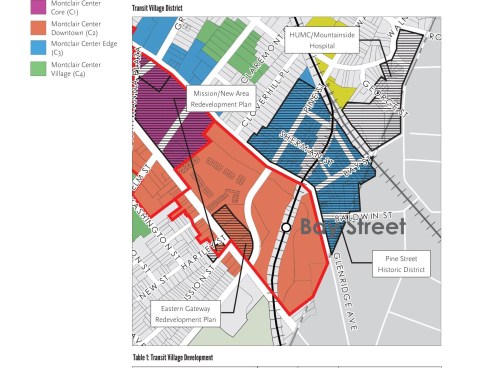
Montclair Township Unified Land Use + Circulation Element May 2015
Economic Development and the Arts – Objective #3
Make Montclair a desirable and convenient place to shop.
Long-term residents of Montclair have witnessed the disappearance of every business they once patronized. Vehicles purchased at the Ford dealership on Bloomfield Avenue, cars serviced at McDonough Tire on the corner of South Willow, appliances purchased at Karl’s and mattresses at Sleepy’s, shopping for groceries at Pathmark and clothing and household goods at Hahnes. Not to mention all the independently owned shops on Church Street that have disappeared. Commercial establishments where necessary goods and services could be procured have been replaced by a smattering of shops offering overpriced non-necessities and overpriced restaurants serving mediocre food.
The deliberate rezoning of Bloomfield Avenue eliminated retail and services that residents could walk to from their homes, forcing them to use their cars to leave Montclair for all their shopping.
Economic Development and the Arts – General Recommendations #3
Consider the benefits of the New Jersey Department of Transportation (NJDOT) Transit Village designation that would include the Walnut and Glenridge commercial districts.
The Montclair Bay Street Station was designated a “Transit Village” in 2012. The Bay Street Station is immediately adjacent to the former red-lined district 21, the location identified in Land Use Development Regulation #1 (Mission, New, Washington and Wheeler Streets – Part IV of Planning for Failure) where the Township utilized illegal Spot Zoning to convert NOAH to luxury housing.
The 2017 NJDOT “Transit Village Progress Report” characterizes a “Transit Village” as having established connecting bus or shuttle service and improved bicycle and pedestrian facilities. Neither of these exist at Bay Street Station. The only shuttle service listed in the report for Montclair is the Montclair State University shuttle, which does not transport passengers to Bay Street Station.
The report identified overall findings of a 2006 research paper “Housing Diversity and Affordability in New Jersey’s Transit Villages” substantiating that the number of affordable housing units remains low among designated villages.
Montclair would have been an exception to this finding had the Township not engaged in illegal Spot Zoning.
The NJDOT “Transit-oriented development” website page characterizes projects that are designed to take advantage of nearby transit and includes features that encourage walking, biking and transit ridership. (If only the State had invested in transit infrastructure to make this concept a reality).
Those characteristics include:
- Mid-block pedestrian cut throughs are provided on long blocks. There is no cut through on either Maple Avenue or Elm Street, both of which are within ½ mile of Bay Street Station, Montclair’s designated “Transit Village”.
- High-quality walking and biking environment. Neither walking nor biking to Bay Street Station are high-quality. There is no bike lane, and pedestrians are frequently forced to share the sidewalks with cyclists and runners.
- A mix of transit-supportive uses. There are no offices, shops, markets, hotels, or boutiques and few restaurants, salons, or coffee shops within ½ mile of Bay Street Station. It is notable that neither The Montclarion nor The Vestry, two luxury apartments complexes immediately adjacent to Bay Street Station have any retail. The Montclarion has no commercial spaces, and The Vestry has one that is occupied by a pediatrician that only opened in mid-2026. The Vestry was completed in 2020. It bears noting that a similar sized project “The Clair” located in the Montclair Center Gateway redevelopment area, was permitted to build a 46-unit project where only 18 units per acre were allowed by code due to an “error” in the ordinance that excepted residential development with street level commercial space. The commercial space in The Clair was also unoccupied for several years.
- The transit station is the prominent feature of the town center including small parks or plazas near the transit station. In Montclair, there are no small parks or plazas near the Bay Street Station.
In the current 2026 reexamination, the Planner seeks to continue making the same mistakes she has made over the past decade and a half, failing to admit her errors, compounding the inequity, financial, environmental and housing insecurity that have already destroyed the 4th ward.
Environment Objectives #2
Preserve open space and identify opportunities to acquire additional open space in areas of the Township which are densely developed.
No efforts have been made to preserve open space, on the contrary, the Planner deliberately and systematically supports developers applying for variances and allowances contradicting existing zoning ordinances.
The 2016 Master Plan Reexamination document relies heavily on ordinances, policies and pledges claiming the Township’s commitment to the environment, but all actions supported by the Planner result in the exact opposite of deliberately unenforceable ordinances and virtue signaling pledges and policies.
For example, the Planner claims the 2006 Master Plan reexamination Environment Objective #2 to preserve open space and acquire additional open space was satisfied by adopting a Conservation Element in 2007.
Similarly, the Planner claims Environment Objective #6 to encourage reduced automobile usage is satisfied by the Sustainable Land Use Pledge the Council adopted in September 2009.
The Montclair Times, June 13, 2013 “Planning Board – Something new for the old Charlie Browns” article states that the Eastern Gateway Redevelopment Plan allows for an expansion of the Montclarion and also calls for the creation of an environmental trust fund that would preserve open space throughout Montclair.
Needless to say, an environmental trust fund to preserve open space throughout Montclair has not been created.
References
- NJDOT, 2017, “Transit Village Progress Report”
- NJDOT “Transit-oriented development” website page
- Montclair Times, 6/13/2013 “Planning Board – Something new for the old Charlie Browns”
Read Part VII, the next installment in the series Planning for Failure: Finance – Part VII of Planning for Failure
 Montclair Progressive or Corrupt