In “Master Plan: A new vision for the future” (The Montclair Times April 18, 2013) former Mayor Jackson “stressed that whatever construction may occur…the town is not spending a dime on new infrastructure. We are saying to developers You can pay us for land, pay us for infrastructure – water lines, sewer lines, road repaving.”
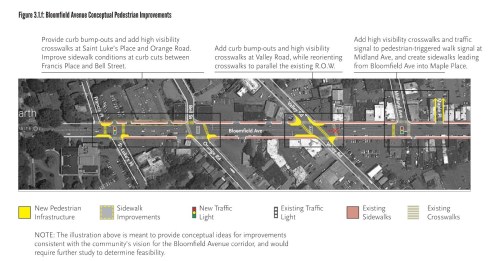
Montclair Township Unified Land Use + Circulation Element May 2015
The 2006 Master Plan reexamination recommended requiring developers to contribute to off-tract improvements directly related to their projects. This recommendation appears in the 2006 and 2016 reexamination recommendations five (5) times and is omitted from the Planner’s 2026 Master Plan Reexamination Report. The number of times this recommendation is listed leaves no doubt that developers’ financial contributions to cover project strain on infrastructure is vital to the municipality’s financial well-being.
| Require developers to contribute to off-tract improvements Directly related to their projects | 2006 Reexamination | 2016 Reexamination | 2026 Reexamination |
| Land Use Objective #3 | Recommendation | Still Valid | Disappeared |
| Land Use Master Plan Recommendation #3 | Recommendation | Unified Land Use and Circulation Plan Element includes recommendation to adopt requirement | Disappeared |
| Land Use Development Regulation Recommendation #3 | Recommendation | Not Implemented | Disappeared |
| Transportation/Traffic/Parking Master Plan Recommendation | Recommendation | Adopted Unified Land Use and Circulation Element | Disappeared |
| Development Regulations Recommendations added in 2016 Master Plan reexamination renamed “Zoning” in 2026 Master Plan Reexamination Report Overview | NA | Create ordinance requiring developers to pay for off-tract infrastructure improvements necessitated by their developments | Disappeared |
The Montclair Township Unified Land Use + Circulation Plan Element includes diluted references to the more robust 2006 Master Plan reexamination recommendations to require developers to contribute to off-tract improvements directly related to their projects, which have never been pursued (See Finance – Part VII of Planning for Failure).
Utilize Density Bonuses to ensure public benefits accompany high-density development (page 29)
The Township should investigate the feasibility of using density bonuses as a tool to ensure that development greater than the currently permitted height and density shall require complementary public improvements that may be on- or off-site. Associated improvements tied to density bonuses may include, but are not limited to, sidewalk/pedestrian infrastructure upgrades, the provision of bicycle parking infrastructure such as dedicated bike storage/parking for visitors and residents, bike share or car share programs or the provision of courtesy loaner vehicles in lieu of parking, and/or contributions to planned public transit improvements. The details of the incentive zoning will be determined in the zoning ordinance.
Evaluate and improve infrastructure as appropriate (page 58)
Improvements to the Township’s aging infrastructure will be necessary as development and redevelopment takes place. The Municipal Land Use Law permits municipalities to adopt ordinances that require developers to pay for their pro rata share of off-tract water, sewer, drainage and street improvements. The Township should conduct a study of the existing conditions and necessary improvements to its existing infrastructure and adopt an off tract improvement ordinance.
In the interim, larger development projects should include an evaluation of the impact of the proposed development to water, sewer and roadway infrastructure. This requirement should be included in all redevelopment plans and required to be addressed at site plan approval.
In addition, the zoning ordinance should be amended to include this requirement for large development projects outside the redevelopment process.
These recommendations, despite their critical importance, have not been pursued, and there is no provision included in the Redevelopment Agreement for the Lackawanna Plaza project approved by the Council in 2026.
Contrary to Jackson’s pledge that residents wouldn’t pay a dime for infrastructure investments required by increased density, it is the developers who haven’t paid a dime. On top of this, the Township has negotiated redevelopment agreements that burden residents with financing generous PILOT concessions in exchange for creating a deteriorating of quality of life for residents coupled with skyrocketing taxes.
PILOT subsidies cost Montclair residents an estimated $100 million over the 30-year terms. This is due to the land tax credit deduction from the PILOT payment calculation. Land assessments are part of the Township’s tax base which determines both School and County assessments. These assessments are not covered by PILOTs and must be paid from the general tax base collected, an additional cost to residents the Township has failed to account for.
References
- Montclair Times 4/18/2013 “Master Plan: A new vision for the future”
- Unified Land Use + Circulation Element – 2015
Read Part III, the next installment in the series Planning for Failure: A poor record of accomplishments – Part III of Planning for Failure
 Montclair Progressive or Corrupt